XTEN-AV alternative
An XTEN-AV alternative aimed at the show, not the install.
Both are cloud AV design tools. The difference is what they are shaped around: XTEN-AV leans toward integration design and deliverables, WireFlow leans toward the flypack, the rack, and the wall you are loading in on Thursday. Free to start, Pro at $14.99/month.
- Port validation while you draw, an SDI output will not land on an HDMI input
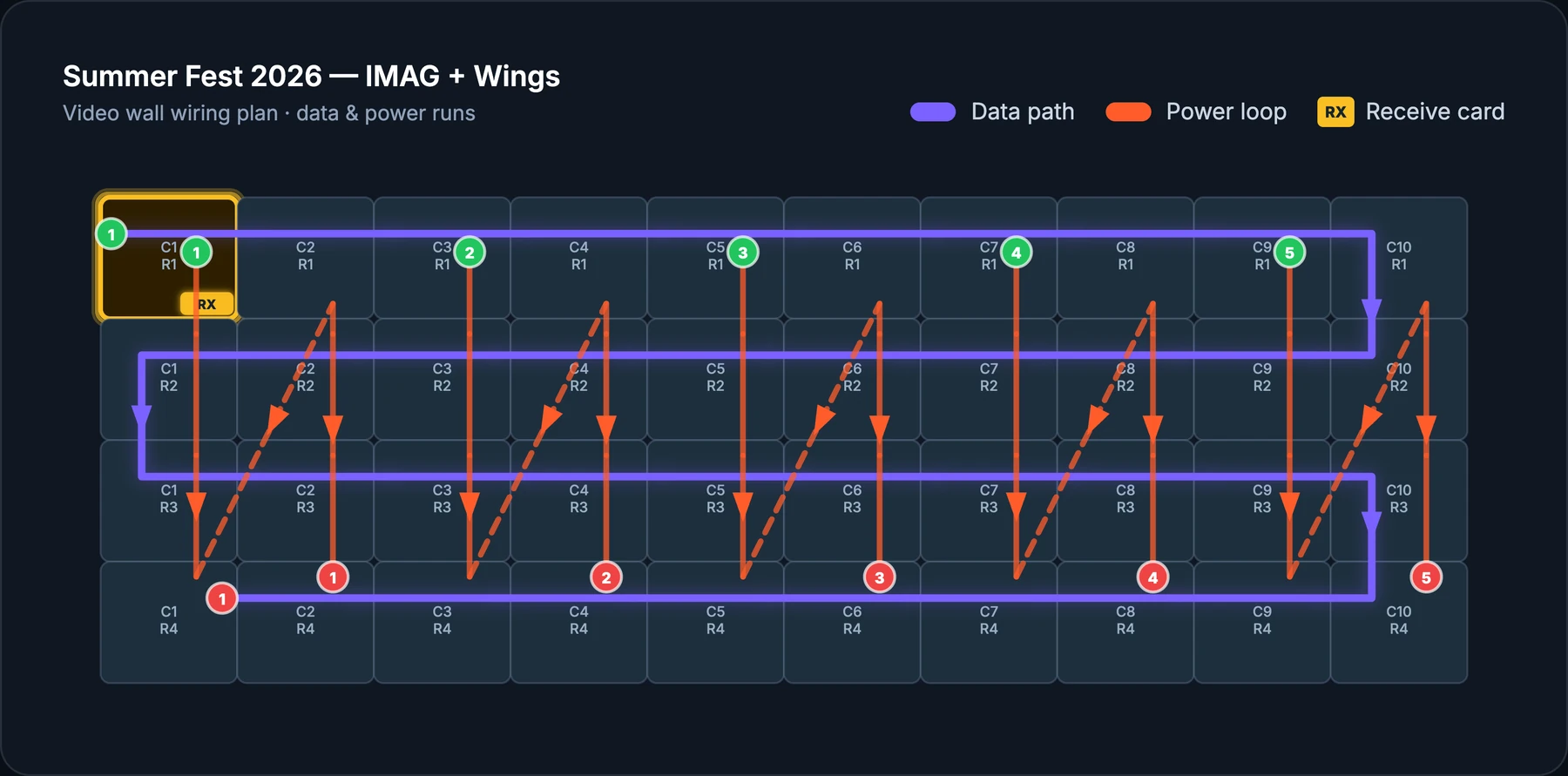
- LED wall builder with cabinet counts, pixel maps, and power per circuit
- Rack elevations with real RU heights, front and rear, in the same project
- Cable schedule and gear list generated from the diagram, not retyped
- Free to start: three editable diagrams, no credit card
Two cloud tools, two different jobs
XTEN-AV is a real product doing real work, and if your output is a construction-documentation set for an integration project, a CAD-oriented design tool is the right shape for that. We are not going to pretend otherwise.
WireFlow is shaped around live production. The unit of work is a show file: sources, switchers, processors, racks, walls, and the patch between them, drawn fast, validated as you go, and handed to a crew that opens it on a phone.
What live production needs that a design tool often does not carry
Touring and event work has a few requirements that generic AV design misses. You need the LED wall math (how many cabinets, what pixel map, how many circuits at what draw). You need rack elevations that match what is actually in the case. You need the cable schedule to change when you move one wire, because you will move a lot of wires.
- LED wall builder that sizes cabinets and produces the pixel map
- Power reporting that totals draw and splits it across circuits
- Signal-path tracing so you can answer why there is no picture on screen 3
Speed matters more than polish on show day
A drawing that takes two days to produce is the wrong tool for a job that got confirmed on Monday for Thursday. WireFlow is built so a competent tech can go from empty canvas to a validated, shareable signal flow inside a session, using a device library with ports already defined.
The output is not a stamped CAD set. It is a clean diagram, a cable schedule, a gear list, and a PDF tech pack that the crew and the client can both read.
Try it against a real show file
The honest test is not a feature grid. Take a show you have already built somewhere else, rebuild it here, and see whether the validation catches anything you had wrong. That is the only comparison that tells you something.
It is free to do that: three diagrams, no card.
Frequently asked questions
- Is WireFlow a CAD tool?
- No. There is no drafting layer, no dimensioned floor plan output, and no construction documentation set. You can drop a floor plan image underneath a diagram as an underlay, but WireFlow produces schematic signal flow, racks, and walls rather than CAD drawings.
- Can I import drawings from XTEN-AV?
- There is no direct importer. Most people rebuild a recurring show file in an afternoon from the device library, and the rebuild is where the port validation catches whatever was quietly wrong before.
- Does WireFlow design LED walls?
- Yes, and it is one of the better reasons to use it. Pick a panel, give it a target size, and it works out cabinet counts, the pixel map, weight, and power per circuit, then drops the wall into your diagram already wired to its processors.
- Does it generate proposals?
- No. WireFlow produces the diagram and the documents that come off it: cable schedule, gear list, power report, and a PDF tech pack. Commercial documents are out of scope.
- Can the crew open it without an account?
- Yes. Read-only share links open in any browser with no login and no install, and they always show the latest saved version.
- What does WireFlow cost to start?
- Free. Three editable diagrams, five custom devices, the full preset library, and PNG export, with no credit card. Pro is $14.99/month and unlocks unlimited diagrams, racks, LED walls, and clean PDF and CSV exports.