AV diagram software compared
AV diagram software, compared honestly by someone who sells one of them.
Eight tools, four pricing models, and one honest map of who each one actually fits, including where WireFlow is not the best pick. Free to start, Pro at $14.99/month.
- Real 2026 pricing for XTEN-AV, D-Tools SI, Stardraw, and the generic diagramming apps, not marketing-page ranges
- Buyer fit for each tool: enterprise integrator, sales-led shop, solo tech, or a spreadsheet-and-Visio shop
- Licensing models side by side: per-user monthly SaaS, annual seat contracts, and perpetual licenses
- Where H2R Gear, EasySchematic, and WireFlow overlap, and where they do not
- Free to start on WireFlow: three editable diagrams, no credit card
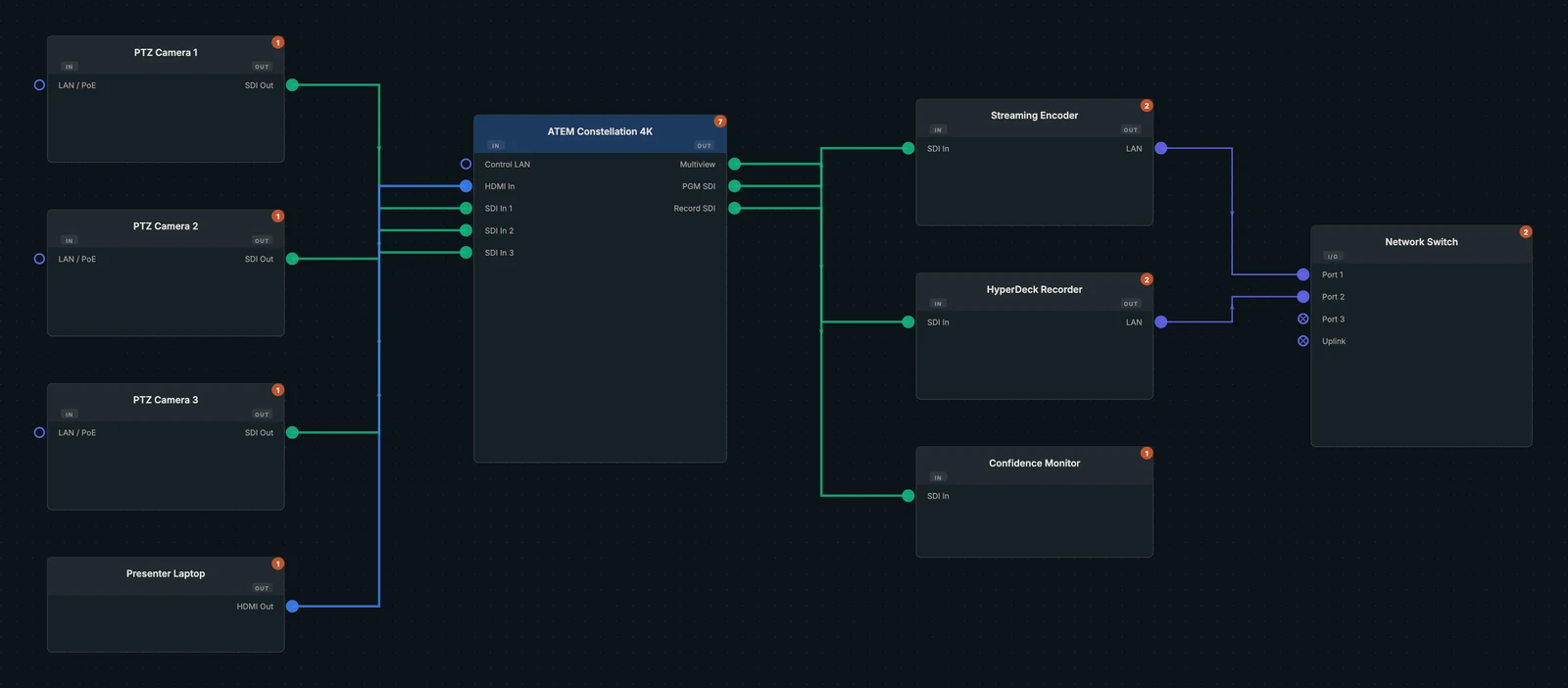
What actually differs between these tools
Every AV diagram tool draws boxes and lines. The differences that matter are underneath: how the vendor prices it, who the sales process assumes you are, whether the software checks a connection or just draws it, and whether it lives in a browser or on one machine.
Those four things predict how a tool will feel to use far better than a feature list does, so that is what this comparison actually weighs.
- Pricing model: per-user monthly SaaS, annual seat contracts, a perpetual license, or free
- Buyer assumption: enterprise integration firm, small AV shop, solo tech, or generic office user
- Validation: does it know an SDI port from an HDMI port, or is a port just a shape
- Deployment: browser-based and cross-platform, or a Windows-only desktop install
The eight tools, in plain terms
In order from the largest integration platform down to the tools built for one person working alone.
- XTEN-AV X-DRAW: cloud AV design software built for integration firms, with construction-documentation deliverables rather than a quick show file. $104-169/user/month depending on plan and billing term, no free tier, and a 15-day trial.
- D-Tools SI: the estimating and procurement platform behind a lot of integration firms, sold sales-led rather than self-serve. $1,800/user/year, a 5-user minimum, and a 1.9M-SKU product library behind the drawing layer.
- Stardraw: a long-running Windows desktop AV drawing tool with a deep manufacturer symbol library. Roughly $550 for the first year, sold as a perpetual license rather than a subscription.
- Vectorworks ConnectCAD: schematic AV documentation inside Vectorworks, so the signal flow sits in the same file as the venue drawings. Strong for consultants delivering a coordinated construction set; everyone who opens it needs a Vectorworks seat. See the ConnectCAD comparison page for the detail.
- Visio, Lucidchart, and draw.io: generic diagramming pressed into AV use. draw.io is free with a community rack shape library, Visio Plan 2 runs $15/month, and Lucidchart is another per-seat SaaS option in the category. None of them know what a port is, so an HDMI output lands on an SDI input without complaint.
- H2R Gear: browser-based AV signal flow software built by the Here to Record livestream-education brand. Free to start, with paid plans from $5/month to $80/month, plus patches, zones, and a community device library. The closest tool on this list to WireFlow. See the full comparison below.
- EasySchematic: a free, open-source (AGPL-3.0) browser tool for AV signal flow, usable with no account. It flags incompatible signal types as you wire, draws rack elevations, produces cable schedules, pack lists, and power reports, exports DXF, PDF, PNG, and SVG, installs as a desktop app that works offline, and has its own MCP server. An optional free account adds cloud saves and share links.
- WireFlow: browser-based AV diagramming with port-aware validation, an LED wall builder, rack elevations, cable schedules, and power reports, plus a public API and an MCP server. Free tier covers three diagrams. Pro is $14.99/month.
Which one should you pick
The honest answer depends on who is buying, not which tool has the longer feature list.
- Running an integration firm with a sales team and a procurement pipeline: D-Tools SI or XTEN-AV X-DRAW, depending on whether estimating or design documentation matters more to you
- Already own a Stardraw license and mostly do one-off AV drawings: Stardraw remains a reasonable perpetual-license option
- Occasionally need an AV-flavored diagram inside a company that already pays for Visio or Lucidchart: keep using it, and know it will not validate a connection
- Consultant delivering a construction documentation set in Vectorworks: ConnectCAD, because the schematic lives in the same file as the building
- Want it free, open source, or fully offline, or need DXF export: EasySchematic is the better pick, and it covers signal flow, racks, and cable paperwork at no cost
- Solo tech, small crew, or house of worship that wants signal flow, racks, and a cable schedule without a sales call: WireFlow, H2R Gear, or EasySchematic, all browser-based and all free or cheap to start
- Need LED wall design with cabinet counts and pixel maps, or a Team workspace for a production company: that is where WireFlow differs from the free tools
Where WireFlow fits, honestly
WireFlow's lane is working crews and small shops: touring techs, house of worship volunteers, corporate AV freelancers, and small integrators who need a validated signal flow, a rack elevation, and a cable schedule today, not after an onboarding call.
It is not an estimating platform like D-Tools, not a design-documentation tool like XTEN-AV, and not a drafting seat like Stardraw. If one of those is what your business actually runs on, this page should point you there instead.
If your problem is closer to needing the diagram to be right and needing your crew to open it on a phone, that is the gap WireFlow and H2R Gear both fill. The detailed comparison between those two is one click away.
Frequently asked questions
- Is this comparison biased since WireFlow is one of the tools?
- Yes, we build WireFlow, and it is one of the tools compared here. We kept every price and fact on this page checkable, and we say plainly where WireFlow is not the right pick: a firm that needs estimating and procurement, or a drafter who needs a plot, should look at D-Tools, XTEN-AV, or Stardraw instead.
- What is the cheapest way to get AV diagram software?
- EasySchematic is free and open source, needs no account, and checks signal types as you wire. draw.io is also free, with a community rack shape library, though it will not validate a single connection. WireFlow's free tier covers three editable diagrams with the full device library and port validation, no credit card required.
- Which tool is built for large integration firms?
- D-Tools SI and XTEN-AV X-DRAW both assume that buyer. D-Tools centers on estimating and procurement at $1,800/user/year with a 5-user minimum. XTEN-AV centers on cloud design and documentation at $104-169/user/month.
- Does any of these tools validate connections automatically?
- WireFlow checks the port types on both ends of a wire and blocks an incompatible patch while you draw it. The AV-specific tools model signal flow to varying depths; Visio, Lucidchart, and draw.io treat every port as a generic anchor point, so an impossible patch draws just fine and fails at load-in instead.
- How is WireFlow different from H2R Gear specifically?
- They are the closest peers on this list. Both are browser-based and both are priced for individuals and small teams. The differences show up in LED wall design, rack elevations, and API access on WireFlow's side, and in patches and zones on H2R Gear's side. See the full comparison for the breakdown.
- How is WireFlow different from EasySchematic?
- EasySchematic is free, open source, works offline, and covers signal flow, rack elevations, cable schedules, power reports, and an MCP server, so for simple schematics at no cost it is the better pick. WireFlow blocks an incompatible patch outright, and adds an LED wall builder with cabinet counts and pixel maps, a Team workspace, and a public REST API for writing diagrams, in exchange for a paid Pro plan.
- What does WireFlow cost to start?
- Free. Three editable diagrams, five custom devices, the full preset library, and PNG export, with no credit card. Pro is $14.99/month and adds unlimited diagrams, racks, LED walls, and clean exports.